Rising Concerns Over Kidney Disease, Cancer, Counterfeit Medicines, and Drug Abuse: UNAVAY Calls for Stronger Regulatory Action in Nigeria
The United Network Against Violence Among Youths (UNAVAY) has called for stronger regulatory oversight of medicines, food products, healthcare services, and drug control efforts in Nigeria. Citing concerns over counterfeit medicines, unsafe products, substance abuse, and unlicensed healthcare practices, the organisation advocates enhanced testing, monitoring, enforcement, and public reporting mechanisms to reduce preventable health risks and protect public health
By UNAVAY team Updated 5 min read
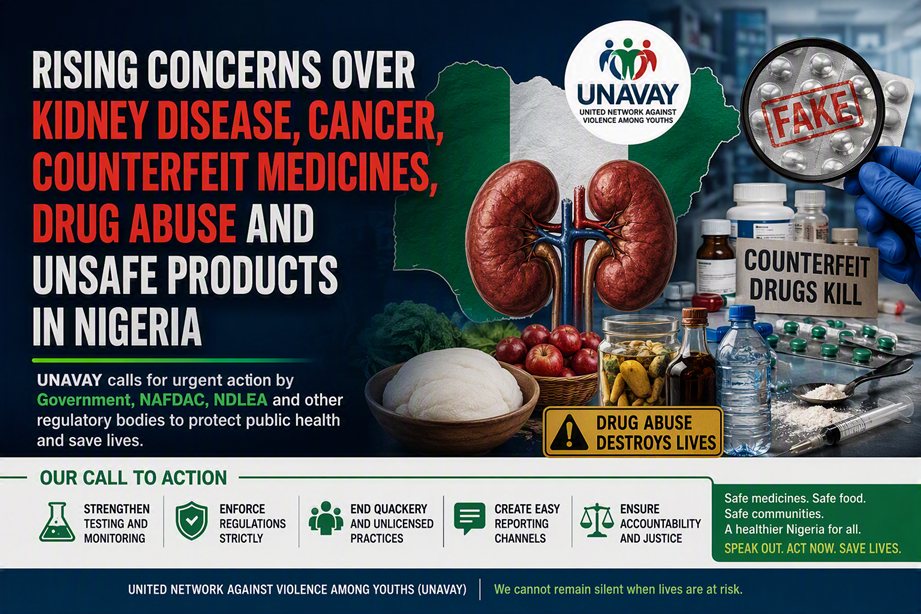
The United Network Against Violence Among Youths (UNAVAY) has called on the Federal Government of Nigeria, the National Agency for Food and Drug Administration and Control (NAFDAC), the National Drug Law Enforcement Agency (NDLEA), and other relevant regulatory institutions to strengthen efforts aimed at addressing the growing concerns surrounding counterfeit and substandard medicines, drug abuse, unsafe food and beverages, healthcare quackery, and their potential impact on public health.
The call was made by the Founder of UNAVAY, Engr. Casmir C. Nguzoro, following a strategic meeting with UNAVAY Ambassadors held this week.
Expressing concern about the increasing number of young Nigerians affected by life-threatening illnesses and substance abuse, Nguzoro emphasized the need for greater collective responsibility in safeguarding public health.
“We are increasingly concerned about the exposure of many young people to counterfeit products, drug abuse, violence, and unregulated healthcare practices. Every stakeholder has a role to play in addressing these challenges. Speaking out and advocating for stronger safeguards is essential because the consequences affect families, communities, and future generations,” he said.
A Growing Public Health Challenge
Chronic Kidney Disease (CKD) remains a major public health concern in Nigeria. Various studies have reported prevalence rates ranging from 2.5% to 26%, depending on the population studied and diagnostic methods employed.
Cancer also continues to place a significant burden on the healthcare system. According to estimates from the International Agency for Research on Cancer (IARC), Nigeria recorded approximately 127,763 new cancer cases and 79,542 cancer-related deaths in 2022.
In addition, the World Health Organization (WHO) estimates that at least one in ten medical products in low- and middle-income countries may be substandard or falsified, posing serious risks to patient safety and treatment outcomes.
UNAVAY acknowledges that diseases such as kidney failure and cancer result from multiple factors, including genetics, hypertension, diabetes, infections, environmental exposures, and lifestyle choices. However, the organisation argues that preventable risks arising from counterfeit medicines, unsafe products, and unregulated healthcare practices should be vigorously addressed through effective regulation and enforcement.
Concerns About Product Safety and Consumer Protection
UNAVAY expressed concern about reports relating to counterfeit medicines, poorly regulated herbal products, substances marketed for sexual enhancement, fake alcoholic and non-alcoholic beverages, and other products whose safety and quality may not always be adequately verified.
The organisation also highlighted public concerns surrounding food preservation and processing practices. Reports and allegations regarding the use of inappropriate chemicals or substances in preserving certain food products, fruits, and locally processed foods have generated considerable public debate.
UNAVAY stressed that such claims should be subjected to rigorous scientific investigation rather than speculation.
“Public concerns should neither be dismissed nor accepted without evidence. Allegations involving unsafe products or harmful preservation methods should be investigated through laboratory testing and scientific verification, followed by appropriate enforcement actions where violations are confirmed,” the organisation stated.
The group further noted that consumers have a legitimate expectation that foods, beverages, medicines, and other products available in the marketplace meet established safety and quality standards.
Strengthening Regulatory Oversight
UNAVAY is urging NAFDAC to intensify product surveillance, laboratory testing, post-market monitoring, and enforcement activities across medicines, food products, beverages, water, and related regulated sectors.
The organisation also advocates for more frequent inspections of manufacturing facilities, distribution centres, pharmacies, warehouses, food-processing plants, and other regulated establishments.
According to UNAVAY, product monitoring should extend beyond the approval stage to include continuous oversight throughout the product lifecycle.
The organisation further called on the NDLEA to sustain and expand efforts aimed at combating illicit drug trafficking and substance abuse, particularly among young people who remain vulnerable to addiction and its associated social consequences.
In addition, UNAVAY urged healthcare regulatory authorities to strengthen measures against unlicensed medical practice and healthcare quackery.
“Every patient deserves safe, competent, and professional healthcare. Individuals who are not appropriately trained, certified, or licensed should not be permitted to diagnose, prescribe medications, administer treatments, or perform medical procedures,” the statement noted.
Enhancing Public Reporting and Accountability
To improve public participation in health and safety oversight, UNAVAY proposes the establishment of an accessible national reporting system through which citizens can report suspected counterfeit medicines, unsafe food products, illicit drug activities, and unlicensed healthcare operations.
The organisation believes that such a system would empower consumers while supporting regulatory agencies in identifying emerging threats and responding more rapidly to potential public health risks.
UNAVAY also called for greater transparency in enforcement activities, including regular publication of information on seized products, sanctioned facilities, revoked licences, and successful prosecutions related to public health violations.
Protecting Lives Through Collective Action
Nigeria’s life expectancy remains relatively low when compared with global averages. According to World Bank estimates, life expectancy at birth in Nigeria was approximately 55 years in 2024.
UNAVAY believes this reality underscores the importance of preventing avoidable illnesses and premature deaths through stronger regulatory frameworks, public awareness, and collaboration among stakeholders.
The organisation called on government agencies, healthcare professionals, manufacturers, food producers, civil society groups, and citizens to work together in promoting safer communities and healthier outcomes.
“The protection of human life must remain a priority. We must continue to strengthen our healthcare systems, combat drug abuse, promote product safety, and ensure accountability wherever public health is endangered,” Nguzoro stated.
UNAVAY emphasised that it is not asserting that counterfeit products are responsible for every case of kidney disease or cancer. Rather, the organisation is advocating for stronger oversight, scientific investigation, robust testing, and consistent enforcement aimed at reducing preventable risks and protecting public health.
The organisation concluded by reaffirming its commitment to public health advocacy, youth development, and the promotion of safer communities.
“We cannot remain silent when lives are at risk.”
United Network Against Violence Among Youths (UNAVAY)